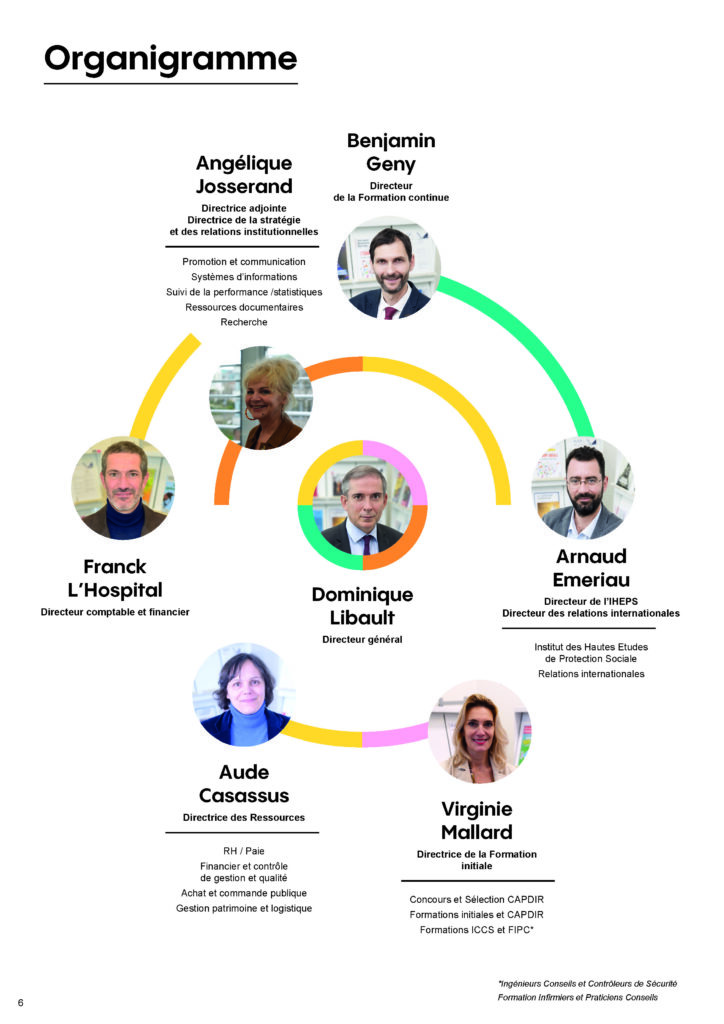
EN3S is a public institution operating under the supervision of the French Ministry responsible for Social Security. Its governance is based on a Board of Directors and a management team, supported by advisory and steering bodies.
Its composition and responsibilities are governed by Articles R.123-11 and subsequent articles of the French Social Security Code. Responsible for managing the School’s general affairs through its deliberations (activities, internal regulations, etc.), the Board meets three times a year.
The members of the Board of Directors, representing the different branches of the French Social Security system, are appointed for a four-year term by decree of the Minister responsible for Social Security and the Minister responsible for Agriculture. The current Chair is Gérard Mardiné, appointed by decree on 27 March 2018.
The School is headed by Dominique Libault, appointed Director of EN3S by decree on 27 April 2012.
A senior French civil servant, Dominique Libault has chaired the High Council for the Financing of Social Protection (HCFiPS) since 2018 and, since 2023, the Steering and Monitoring Committee for the Departmental Public Service for Autonomy (SPDA). A graduate of Sciences Po Paris and a former student of the École Nationale d’Administration (ENA), he served as Director of Social Security from 2002 to 2012, during which he contributed to major structural reforms such as the creation of Complementary Universal Health Coverage (CMU-C) and pension reforms. As a member of the Conseil d’État, he notably supervised the national consultation process on ageing and autonomy (“Grand âge et autonomie”) and authored landmark reports on autonomy and ageing
The School’s Departments
The School’s activities are organised within the following departments:
The International Relations Department (DRI)Les activités de l’École sont organisées au sein des directions suivantes :
The Institute for Advanced Studies in Social Protection (IHEPS)
The Strategy and Institutional Relations Department (DISRI)
The Resources Department (DR)
The Accounting Agency
The Initial Training and Degree Programmes Department (DIFI)
The Continuing Education Department (DFC)
The National Pedagogical Commission (CPN)
An advisory body chaired by the Director of the School, the National Pedagogical Commission plays a central role in shaping the training programmes and research activities conducted at EN3S. Composed in particular of representatives from the national Social Security funds, it provides guidance and support regarding access to degree programmes, identification of the network’s training needs, and the co-design of new or revised educational programmes.
The scientific advisors of EN3S and IHEPS, who are experts in social protection, support the School in the design and coordination of teaching activities, studies, and research.
Three experts currently serve as scientific advisors:
On behalf of EN3S:
Julien Damon, lecturer at Sciences Po and HEC
On behalf of IHEPS:
Benjamin Ferras, Inspector General of Social Affairs (IGAS)
Gilles Nezosi, Chief Executive Officer of CTI
The Scientific Advisory Board (COS)
The School’s Scientific Advisory Board, composed of experts in social protection from both institutional and academic backgrounds, is responsible for validating the roadmap and themes relating to research and publications. In particular, it contributes to reflections and decisions concerning the themes of the journal Regards and the School’s research and studies programme.
Pour offrir les meilleures expériences, nous utilisons des technologies telles que les cookies pour stocker et/ou accéder aux informations des appareils. Le fait de consentir à ces technologies nous permettra de traiter des données telles que le comportement de navigation ou les ID uniques sur ce site. Le fait de ne pas consentir ou de retirer son consentement peut avoir un effet négatif sur certaines caractéristiques et fonctions.
Fonctionnel
Always active
L’accès ou le stockage technique est strictement nécessaire dans la finalité d’intérêt légitime de permettre l’utilisation d’un service spécifique explicitement demandé par l’abonné ou l’utilisateur, ou dans le seul but d’effectuer la transmission d’une communication sur un réseau de communications électroniques.
Préférences
L’accès ou le stockage technique est nécessaire dans la finalité d’intérêt légitime de stocker des préférences qui ne sont pas demandées par l’abonné ou l’internaute.
Statistiques
Le stockage ou l’accès technique qui est utilisé exclusivement à des fins statistiques.Le stockage ou l’accès technique qui est utilisé exclusivement dans des finalités statistiques anonymes. En l’absence d’une assignation à comparaître, d’une conformité volontaire de la part de votre fournisseur d’accès à internet ou d’enregistrements supplémentaires provenant d’une tierce partie, les informations stockées ou extraites à cette seule fin ne peuvent généralement pas être utilisées pour vous identifier.
Marketing
L’accès ou le stockage technique est nécessaire pour créer des profils d’internautes afin d’envoyer des publicités, ou pour suivre l’utilisateur sur un site web ou sur plusieurs sites web ayant des finalités marketing similaires.